
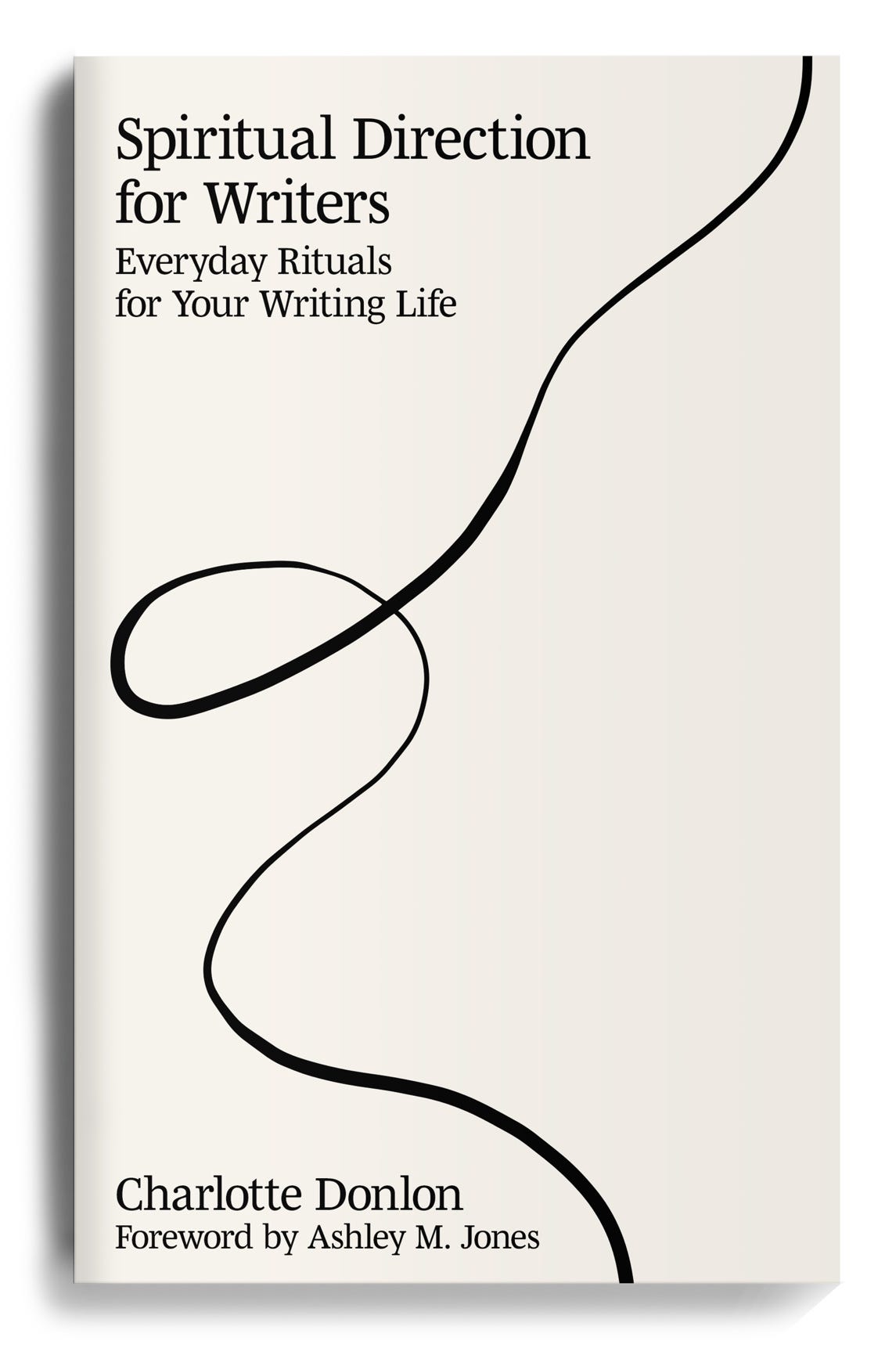
If you’re a writer or journaler with a soul, you’ll like Spiritual Direction for Writers: Everyday Rituals for Your Writing Life. If you’re a writer or journaler without a soul, you should skip it. There are plenty of other books out there.
Also, this is a work in progress. I’ll be adding quotes and switching them out often and sharing them daily.
From the Foreword by Ashley M. Jones
Sometimes the hardest part of being a writer isn’t navigating the business, it isn’t learning all the forms and styles of writing, and it isn’t even killing your darlings. The hardest part, often, is to begin. Sometimes, the page feels lonely. Sometimes, it’s hard to find stillness and quiet inside yourself. And, sometimes, there is help—for me, God is always there with me to help me make it through the writing process. Sometimes, God sends friends and loved ones to help us along.
Charlotte Donlon’s Spiritual Direction for Writers is that friend, that connection to self, and that partner on the page. This book is gentle in its encouragement, and it gives real, useful advice from Charlotte’s own experiences, but also from writers like Toni Morrison, Margaret Walker, and Kaveh Akbar. This type of close look at other writers is so crucial in building a writing life, which, as Charlotte points out, is “all of life.” As a beginning writer, many years ago, it was vital that I understood the humanity of all the writers I admired—that they created the work which made me feel like I belonged, just like the work I am trying to create, as an exercise of self- discovery and stillness. They, too, had to find out where to begin, where to dive in, where to pause, and where to begin again. None of us is above the process, and none of us can shortcut the process. - Ashley M. Jones, Spiritual Direction for Writers: Everyday Rituals for Your Writing Life
From The Prefatory Note
Spiritual direction, says Father James Martin, includes “empathetic listening, paying attention, affirming, assisting in clarification, raising questions.” Such qualities form the heart of a process that is less about giving instructions and more about creating a sacred space for attentive presence. “A spiritual director,” Father Martin adds, “doesn’t direct as much as listen and notice, and help the directee listen and notice.” - Charlotte Donlon, Spiritual Direction for Writers: Everyday Rituals for Your Writing Life
From Three Blessings
First, a “real writer” is anyone who writes.
If you hesitate to call yourself a writer because you don’t write every day, please cease that nonsense. (Best heard with my Alabama drawl.) When asked about their creative practices, celebrated writers describe a wide variety of approaches to the page. Some write every day; some only write on the weekends. Some pass long seasons of fallow time between books or poems. Some writers work best during focused retreats. There are as many different writing rhythms as there are writers.
- Charlotte Donlon, Spiritual Direction for Writers: Everyday Rituals for Your Writing Life
From Before We Begin
“Before” carves sacred corners in ordinary time. Whether we’re writing in stolen moments between obligations or during carefully husbanded hours free from interruption, each beginning holds the weight of the past and the lightness of what’s possible. We write with and before others who have written, with and before our readers, with and before the divine who holds all our words and worlds.
Every “before” is both an ending and a beginning where preparation meets possibility. Here, in this moment, we commit our full selves to the page, ready to receive whatever gifts await in the sacred act of writing. - Charlotte Donlon, Spiritual Direction for Writers: Everyday Rituals for Your Writing Life
From Begin
One way to begin anything is to start where you are.
“In the midway of this our mortal life” is the first line of Dante’s Inferno, a book that begins in medias res, or “in the midst of things.” The reader is plopped down into the middle of the action without context for the character’s formative history, physical setting, or where they are in the narrative arc. In the early pages of this epic, Dante, himself the poem’s narrator, is lost in a forest at night and trying to find his way.
Readers enter a different tangle of dark woods in the first paragraph of Jesmyn Ward’s novel Let Us Descend. The narrator describes a childhood memory of her mother waking her in the middle of the night and taking her “deep, deep into the murmuring trees, black with the sun’s leaving.” The two trek far from a house of harm, away from the man whose skin is as white as the mother’s is dark. They flee this man who believes he owns them.
Both stories begin in the depth of night in a wooded thicket. Both begin in the middle of the action. Dante’s narrator is disoriented and navigating a gloomy and dangerous space. Ward’s narrator knows exactly where she is and that her mother is ushering her to a place of safety.
One way to begin writing is to start where you are. Even if where you are is a dark forest. - Charlotte Donlon, Spiritual Direction for Writers: Everyday Rituals for Your Writing Life
From Belong
(Coming soon!)
From Become
(Coming soon!)
From Behold
(Coming soon!)
From Bestow
(Coming soon!)
From Begin Again
(Coming soon!)
Charlotte Donlon is a writer, spiritual director, creativity coach, and faculty member for Alma College MFA’s spiritual writing pathway. Her writing and work have woven together themes of belonging, art, and soul exploration for more than 25 years. With a Master of Fine Arts in creative writing (2015-2018), a certificate in spiritual direction (2018-2020), and a life coach certification (2026), Charlotte guides writers and other creative souls in developing sustainable and nourishing practices so they can make their art, do their work, and love their people.
A Christian in the Episcopal church who believes the tenets of the Nicene Creed, Charlotte employs a universal framework of belonging and connection in her spiritual direction work. She fosters meaningful, soulful conversations and gatherings that are welcoming to all—regardless of faith tradition or spiritual inclinations.
In 2020, Broadleaf Books published Charlotte’s first book, The Great Belonging: How Loneliness Leads Us to Each Other. Here Below, a new imprint of Eerdmans, published Spiritual Direction for Writers: Everyday Rituals for Your Writing Life in 2026. Three volumes of Charlotte’s “Guidebooks for the Soul”—Take More Retreats, The Great Belonging Project, and Belonging Through Art—will also be published in 2026 and 2027.
As the founder of several initiatives—including Spiritual Direction for Writers®, Parenting with Art®, Belonging Through Art™, and Spiritual Direction for Creative Souls™—Charlotte is an established thought leader and authentic presence at the intersection of creativity and spirituality.
Her essays have been featured in publications such as The Washington Post, The Christian Century, Literary Hub, Writer’s Digest, Brevity, and The Millions. An essay about art conservation, Joan Mitchell, and mystery is forthcoming with Image journal.
For those interested in staying updated on Charlotte’s latest work, news, insights, and offerings, subscribe here and visit Flourish Anyway®.